
BAMBOO SAX SONGBOOK TABLATURE
The following is a gift from customer Mitch Kwartler, we have all been waiting for this to come down the pike. My sincere gratitude for all your time and energy. Thanks Mitch, from us all.
INTRODUCTION
Most of the songs included in this songbook can be played on any of Erik’s Bamboo Sax (Soprano, Alto or Tenor). By playing the same holes on the different instruments, you are really just transposing the song into a different key. You may find, though, that some songs sound better when played in one particular key. Use your own judgement.
Often, there is more than one way to “play” a song. In most cases, the notes and phrasing listed here represent the song’s basic skeleton, without any fancy embellishments. Like all forms of music notation, use this songbook as a guide to help find the notes, and then throw it aside and really play. A notable exception is “Amazing Grace”. For this song, I have listed the basic notes in the first stanza, and then an example of a way to embellish in the second stanza.
BACKGROUND
My original goal was to simply write down the holes to cover to be able to repeatedly play the songs that I learned. As my skill level increased, so did the complexity of the songs I wanted to play. I found that just knowing the notes did not always mean I could correctly play the song. I often needed to know (or just be reminded of) the length of the notes and the “phrasing” of the musical segments.
There are several different ways to write down music. The first is the standard musical notation on sheet music that we are all familiar with. It gives the most detail, but requires they greatest effort to learn and work with. The second is called abc notation. This is a system of writing the actual musical notes with regular alphabetical letters. It provides less detail than standard notation, but is easier to read. Its main drawback is that you have to know what notes each hole produces, and it is harder to transpose music from one key to another.
Tablature (TAB) is a method of writing down music so it can be shared and played by anyone. TAB assumes no previous knowledge of notes or the ability to read sheet music. Instead of using symbols like those used in standard musical notation, it uses ordinary ASCII characters and numbers.
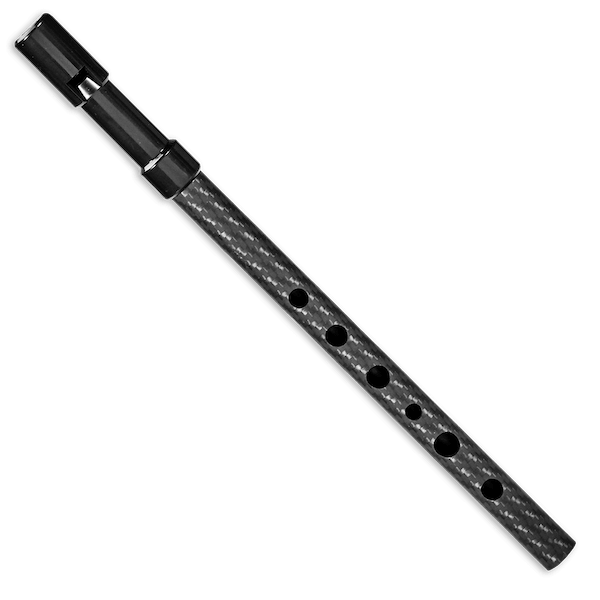
There are two types of TAB. The first is in a graphical representation. This would show a picture of the seven holes on the Sax, with the holes that are to be covered blacked out. This would make learning the fingering very easy, but would not allow any additional information (like length of note or phrasing). It also would require more space to write each song, as each note would require seven lines.
The method I’ve chosen for this songbook uses numbers and letters to denote the holes to cover and some simple symbols to provide additional information.
The TAB will tell you what notes to play. It will tell you where one phrase of music stops and where the next starts. It will give you an indication of the rhythm of the piece - i.e. it will tell you which are the long notes and which are the short notes. However it will not tell you exactly how long or how short they are. It is usually left up to you to listen to the song to pick up the nuances.
Obviously it will be a lot easier to play the TAB for a song you know well than for a song you've never heard of because you will already be familiar with the rhythms of the familiar song.
TABLATURE RULES
Numbers/Letters with single space between play for 1 beat.
Numbers/Letters with no space between play for ½ beat.
Numbers/Letters with slash [/] between slur or play as 1 note.
Greater Than sign [>] holds note for 1 beat.
Two Greater Than signs [>>] hold note for 2 beats.
Dashes [- -] separate musical phrases.
Parentheses ( ) enclosed notes are optional i.e. (6 on last stanza).
Brackets [ ] enclose comment i.e. [Repeat].
Half Notes: Some half notes are more effective when achieved by rolling the finger from closed to half open. Some times half notes can be more clearly heard when played with their alternate fingerings by covering different hole combinations [see Tablature Fingering Chart].
High Notes: Although the Bamboo Sax is considered to be a 1 octave instrument, for ease of recognition, any note played with the back hole [0] open will be written with a capital H [Hi1, Hi2, Hi3]. Some notes in the 2nd octave can be reached by overblowing and/or changing the shape of your mouth while blowing.
TABLATURE FINGERINGS